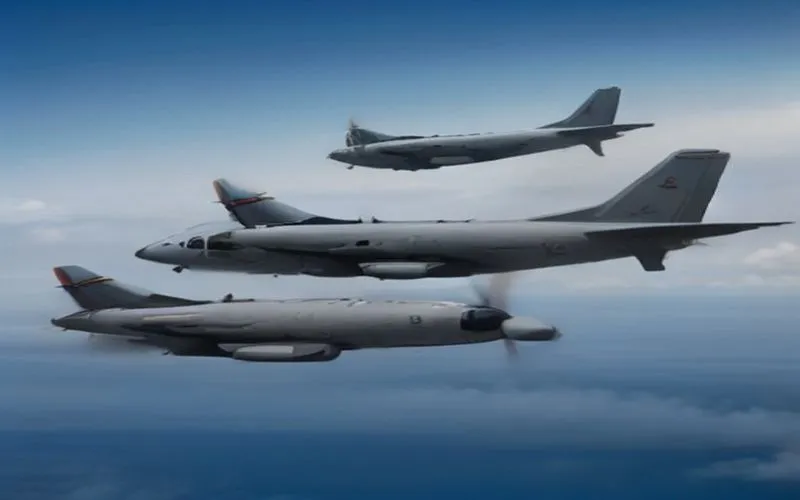
China is significantly advancing its military aviation capabilities with the emergence of its new medium-sized tactical airlifter, now designated as the Y-15. Developed by the Shaanxi Aircraft Corporation (SAC), this four-turboprop transport aircraft has surfaced with clearer imagery and serial numbers indicating active flight testing. Previously speculated upon under the moniker 'Y-30' after a model was showcased at the 2014 Zhuhai Airshow, the Y-15 represents a crucial generational leap for the People's Liberation Army Air Force (PLAAF) as it seeks to phase out its aging transport fleets.
Design Characteristics and Propulsion Systems
The Y-15 features a distinctive configuration equipped with four turboprop engines driving six-blade high-efficiency propellers. Visually, it bears superficial resemblances to Western designs like the Airbus A400M due to its broad fuselage, rear loading ramp, high-mounted wing, and T-tail. However, defense analysts note that it is a smaller aircraft in a different performance class, utilizing WJ-10 turboprops that produce approximately 6,800 horsepower each, contrasting sharply with the much heavier powerplants of the European A400M.
Compared to China's existing Y-9 transport—which is a modernized derivative of the Soviet-era Antonov An-12 design—the Y-15 offers a larger internal cargo space with increased height and width to accommodate bulkier payloads. Unconfirmed testing estimates suggest a potential payload capacity of around 30 metric tons, providing the PLAAF with a highly versatile tactical transport capable of handling oversized military equipment that previously required heavier logistical planning.
Operational Role and Strategic Significance
The introduction of the Y-15 is expected to fulfill critical tactical airlift roles where larger jet-powered airlifters, such as the Y-20, are impractical. Thanks to its robust landing gear and turboprop propulsion optimized for short-field performance, the aircraft is explicitly designed to operate from austere, shorter, or rougher runways close to the front lines. This capability is vital for rapid troop deployments, logistics, and airborne assault operations in challenging geographical terrains such as remote mountain regions or isolated island outposts.
Furthermore, military aviation experts anticipate that the Y-15 airframe will eventually serve as a baseline for specialized variant development, mirroring how earlier Y-8 and Y-9 platforms were adapted into electronic warfare, airborne early warning, and reconnaissance configurations. Beyond its domestic service within the PLAAF, the Y-15 could emerge as an attractive export option for international buyers seeking modern tactical airlift solutions free from Western regulatory restrictions.
Future Outlook and Production Timeline
As flight testing ramps up following the initial appearance of prototype imagery, aerospace observers will closely monitor the program's development. Key milestones will include verifying its estimated performance metrics, evaluating its WJ-10 engine reliability, and observing how quickly SAC transitions from prototype testing to full-scale serial production. The Y-15 stands as a testament to China's sustained efforts to modernize its military logistics and project power across diverse regional theaters.
Bu haber, Ajans Savunma editoryal standartları çerçevesinde Yapay Zeka destekli algoritmalar tarafından orijinal kaynaktaki teknik verilere sadık kalınarak yeniden derlenmiştir. Orijinal Kaynak: The War Zone (Global)



Yorumlar (0)
Henüz yorum yapılmamış. İlk yorumu siz yapın!
Bir Yorum Bırakın