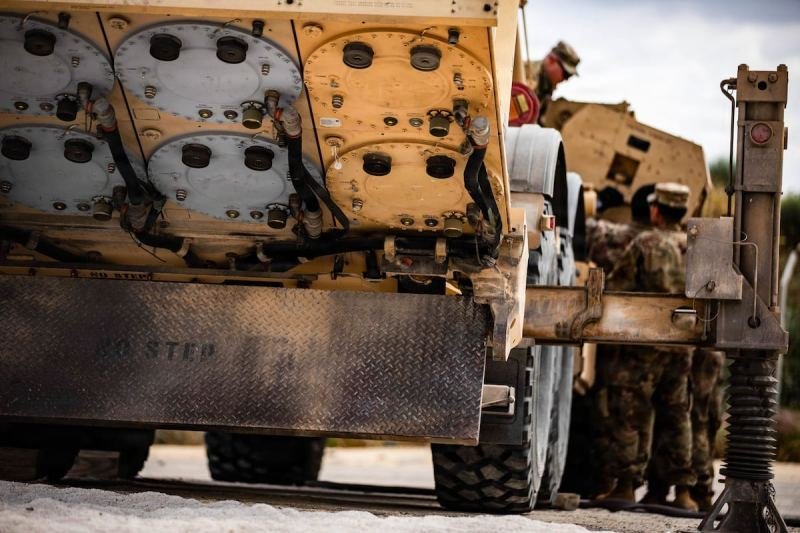
The Defense Department on Monday announced framework agreements with Northrop Grumman and Lockheed Martin aimed at expanding production of critical Patriot and Terminal High Altitude Area Defense, or THAAD, interceptor components as the military seeks to replenish missile inventories through expanded, long-term production capacity.
The agreements come as demand for Patriot and THAAD interceptors has increased following conflicts in Iran and Ukraine that strained U.S. missile inventories. They also come days after a Center for Strategic and International Studies analysis estimated the United States had depleted roughly two-thirds of its pre-war Patriot interceptor inventory during the conflict with Iran.
Defense officials said the agreements are intended to support the department’s long-term procurement objective of nearly 14,000 Patriot and THAAD interceptors by providing sustained demand signals to critical suppliers throughout the defense industrial base. The initiative is designed to triple production capacity for Patriot Advanced Capability-3, or PAC-3, Missile Segment Enhancement interceptors and quadruple production capacity for THAAD interceptors.
DoD said it will work directly with key component suppliers instead of relying solely on prime contractors, encouraging investment in advanced tooling, facility modernization and workforce development needed to sustain higher production rates.
“Building the Arsenal of Freedom requires robust, dynamic supply chains at every level of the industrial base,” Michael P. Duffey, under secretary of defense for acquisition and sustainment, said in a statement. “Framework agreements with munition components suppliers like Northrop Grumman are vital to accelerating the tripling of PAC-3 and quadrupling of THAAD interceptor production.”
The agreements establish a second source for Patriot solid rocket motors, expand production of ignition safety devices for PAC-3 interceptors and increase manufacturing capacity for key THAAD structural components, including mid-body shells, muzzle covers and rail car assemblies.
The initiative is part of the Defense Department’s Acquisition Transformation Strategy and was developed in coordination with the Missile Defense Agency, the Munitions Acceleration Council and the Economic Defense Unit to strengthen the resilience of the missile production supply chain.
About Natalie OliverioNatalie Oliverio is an independent journalist and Navy veteran who covers military and veterans’ issues. Drawing on her experience as a talent executive and mentor, she writes about the policies, people and programs shaping the military community.
Share:More In Pentagon & CongressTrust between operators, CCAs starts with simulations: Former Air Force secretarySimulations and exercises will be key to boosting trust between operators and CCAs, according to former U.S. Air Force secretary Frank Kendall.Celebrating 40 years of Defense NewsSince 1986, Defense News has been the authoritative voice for the world's defense decision-makers.Guardsman learns to fly autonomous Black Hawk in less than an hourIn a training first, an Army National Guardsman used a tablet to control Sikorsky's optionally piloted Black Hawk and plan its task during an exercise.Recap: Highlights from the US Army’s 2025 conference in WashingtonThe Army continues to transform, with efforts focused on next-gen weaponry, long-range artillery, unmanned systems and much more.Pentagon stages first ‘Top Drone’ school for operators to hone skillsIndustry and military drone operators flew tethered and untethered first-person drones through a course designed to test endurance and maneuverability.

Yorumlar (0)
Henüz yorum yapılmamış. İlk yorumu siz yapın!
Bir Yorum Bırakın