The TWZ Newsletter
Weekly insights and analysis on the latest developments in military technology, strategy, and foreign policy.
Email address Sign Up Thank you!Terms of Service and Privacy Policy
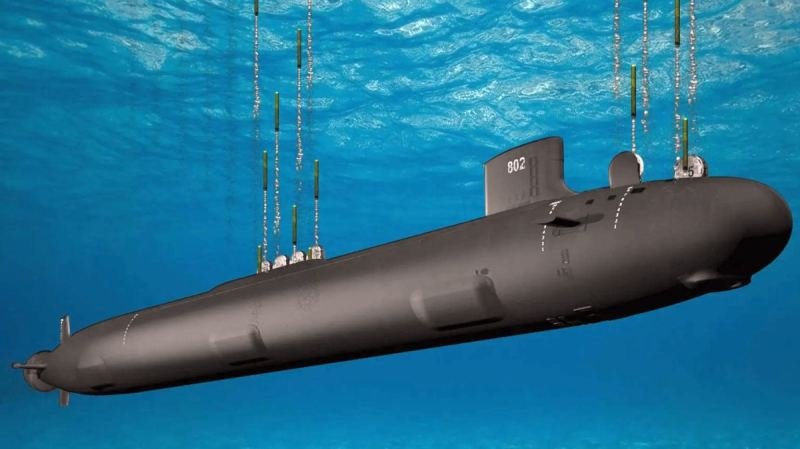
Future subvariants of the U.S. Navy Virginia class nuclear-powered attack submarine (SSN) fitted with Virginia Payload Modules (VPM) will now be categorized as guided missile types (SSGN) instead. The VPM is an 84-foot hull extension that contains four additional large vertical tubes designed to launch Tomahawk land-attack cruise missiles, Intermediate-Range Conventional Prompt Strike (IRCPS) hypersonic missiles, and other payloads. The recategorization decision comes as the service is moving to retire all four of its Ohio class SSGNs by the end of 2029. The Ohio SSGNs are some of the most capable and heavily-in-demand submarines in the Navy’s inventory today.
The Navy currently plans to acquire 19 VPM-equipped Virginia class SSGNs, according to a press release the service put out today. The first boat in this class to feature the VPM will be the future USS Arizona, which is actually the second Block V subvariant being built. The first Block V version, the future USS Oklahoma, will lack a VPM, but the other 10 boats in this batch are expected to have this feature.
【P1】 The submarine currently under construction appears to be USS Arizona (SSN-803), the second Block V Virginia-class attack submarine. 【P2】 is likely the Virginia Payload Module (VPM), a key feature of the Block V variant.
USS Arizona will be the first Virginia-class… https://t.co/lNVxk5TZfe pic.twitter.com/oUJLZEMkGd
Block VI Virginia class submarines are also expected to have VPMs, as well as other upgraded capabilities. However, last week, the Navy announced a new monster $76.6 billion contract award for nine Block VI boats, as well as five additional Columbia class nuclear ballistic missile submarines, or SSBNs. This creates a discrepancy of one submarine (11 Block Vs together with nine Block VIs, for a total of 20, not 19) when it comes to the stated SSGN plans. One possible explanation might be that the outlier is a planned one-of-a-kind seabed espionage subvariant. TWZ has reached out to the Navy for clarification.
A graphic from a General Dynamics Electric Boat presentation in 2022 showing the planned evolution of the Virginia class beyond the Block V subvariant, including the planned one-of-a-kind seabed espionage boat. General Dynamics Electric BoatRegardless, the decision to formally recategorize Virginia class submarines with VPMs as SSGNs is significant.
“This reclassification is a clear acknowledgment of the increased lethality VPM brings to the undersea fight,” Navy Vice Adm. Rob Gaucher, Director of Submarine Programs, said in a statement. “These VPM-equipped SSGNs will ensure the Navy continues to dominate the undersea domain for decades to come. By integrating this additional payload capacity, we will have the ability to surge strike power to assure our allies, deter aggression, outmatch any adversary, and give our Fleet commanders an incredibly versatile, hard-hitting instrument of national power.”
A briefing slide offering a general look at the Virginia Payload Module (VPM) that will be incorporated in Block V Virginia class submarines. USN“Reclassifying Virginia Payload Module-equipped submarines as SSGNs accurately reflects the extraordinary strike capacity, operational flexibility, and global reach these platforms bring to the Fleet,” Navy Adm. Daryl Caudle, Chief of Naval Operations (CNO), the service’s top office, also said in his own statement. “These submarines will provide our Nation with a powerful and persistent deterrent, expand options for our combatant commanders, and ensure the Navy remains ready to fight and win whenever and wherever called upon.”
Virginia class submarines with VPMs do have significantly greater magazine depth than their predecessor. Block I and II boats had vertical launch system (VLS) arrays capable of firing a dozen Tomahawks. Block III and IV versions have a pair of Virginia Payload Tubes (VPT) in place of the earlier VLS configuration, but with the same number of tubes (12) for Tomahawks.
The Block III Virginia class submarine USS John Warner seen at its commissioning ceremony with one of its two Virginia Payload Tubes open. USNVPM-equipped types will be able to carry 28 more Tomahawks for a total load of 40. Using different inserts, future Virginia class SSGNs will be able to carry other munitions in those tubes. This includes the aforementioned IRCPS hypersonic missiles. The Navy is also now looking to acquire a surface-to-air missile designed to be fired vertically from these submarines, which you can about here.
A slide from a 2021 Navy briefing providing a visual overview of the IRCPS program, including the Advanced Payload Module (APM) insert that will allow those missiles to be fired from the VPM’s tubes. The Navy is also working to arm its Zumwalt class destroyers with IRCPS missiles. The Navy’s program also shares a common missile and other elements with the U.S. Army’s ground-based Dark Eagle weapon system. USNIt should be noted here that all Virginia class submarines have four 21-inch torpedo tubes, which also offer another option for launching Tomahawks. They can also be used to fire Harpoon anti-ship cruise missiles, as well as launch and recover uncrewed underwater vehicles (UUV). It’s also possible, if not highly probable, that the VPMs will be capable of launching (and potentially recovering) other payloads, including additional uncrewed platforms.
Some existing Virginia class submarines can be fitted with Dry Deck Shelters (DDS) on top of their hulls for deploying special operations forces, swimmer delivery vehicles (SDVs), and other assets, as well. That is a capability that could be carried over to the enlarged SSGNs.
US Navy Virginia Class Submarine passing Gourock inbound for Faslane – Dry Deck Shelter (DDS) for Navy Seals attached #USNavy #Navy #submarine #Shipping pic.twitter.com/NXGPN1HSmr
— Iain Cameron (@ScotlandDX) December 27, 2018All of this brings us to the matter of the Ohio SSGNs. These boats are best known for being able to carry up to 154 Tomahawks at once, though they more typically deploy with loads of around 100 of those missiles. However, these submarines, which were converted from Ohio class SSBNs, are really multi-mission platforms. Beyond their ability to launch barrages of dozens of Tomahawks, they can act as motherships for special operations forces and uncrewed platforms, as well as serve as underwater intelligence fusion nodes and command centers. You can about their capabilities in this past War Zone feature.
A graphic offering a very general overview of the full breadth of features found on Ohio class SSGNs. USN“This transition [in categorization from SSN to SSGN] comes at an important moment as USS Georgia, one of the Navy’s four Ohio class guided-missile submarines, begins the inactivation process after more than four decades of exceptional service,” CNO Caudle also said in his statement today. “Georgia and her sister ships proved the enduring value of combining undersea stealth with unmatched clandestine strike capability. The next generation of Virginia class SSGNs builds on that legacy with greater survivability, adaptability, and sustained combat power.”
USS Georgia returned home from its final scheduled operational patrol last month. It is now scheduled to be formally inactivated next year.
At the same time, as TWZ has noted for years, the VPM-equipped Virginia class boats will not be a one-for-one replacement for the Ohio class SSGNs, at least based on what is publicly known about the former’s expected capabilities. Just in terms of missile launch capacity, each one of the converted Ohios is equal to roughly four Block V/VI Virginias. This means the Navy will need to field 16 new Virginia SSGNs before it fills the gap left by the retirement of USS Georgia and its three sisters, and can then start adding capacity with three additional boats. The Navy is facing a broader deficit in VLS capacity across its surface and subsurface fleets in the coming years, due also in part to the impending retirement of the last of its Ticonderoga class cruisers.
USS Georgia seen after its final return to Naval Submarine Base Kings Bay in Georgia in July 2026. USN/Petty Officer 1st Class Travis AlstonIt is unclear what other capabilities the Block V and VI Virginia class submarines might have that will help make up for the loss of the specialized intelligence gathering and command and control tasks currently performed by the Ohio class SSGNs. As noted, some existing Virginia class submarines also perform the special operations support mission, but on a more limited level.
“By putting high-volume, long-range precision strike capabilities directly into the hands of the Fleet, these SSGNs will serve as a vital cornerstone for Distributed Maritime Operations and high-end warfighting,” the Navy’s press release today says. “Once operational, these highly survivable platforms will be dynamically employed across crucial global theaters – providing persistent forward presence, reinforcing robust alliance deterrence, and standing ready to project decisive combat power at a moment’s notice.”
On top of all this, the Navy does not expect the full fleet of 19 Virginia SSGNs to be in service until Fiscal Year 2038, at the earliest. This will be nearly a decade after the last Ohio SSGNs sail into mothballs. Concerns are regularly voiced now about the ability of General Dynamics Electric Boat and Newport News Shipbuilding (a division of Huntington Ingalls Industries) to keep up with demand for submarines in this class. There is even more pressure on the program with the addition of plans to sell some of those boats to Australia as part of the trilateral Australia-United Kingdom-United States (AUKUS) defense pact. The Navy is hoping to see the Virginia class production rate eventually rise to two per year, but is not expecting that to come until sometime in the 2030s.
If nothing else, the Navy has at least outlined more of a formal plan to supplant the Ohio class SSGNs with what it has now dubbed Virginia class SSGNs.
Contact the author: joe@twz.com
Joseph Trevithick
Deputy Editor
Joseph is TWZ’s Deputy Editor, helping to oversee the site’s highly experienced and dedicated team, while also writing informative and impactful defense and national security content. He lives right in the thick of it in the Washington, D.C. area.
Loading comments…
Comments couldn’t be loaded. Please refresh the page.


Yorumlar (0)
Henüz yorum yapılmamış. İlk yorumu siz yapın!
Bir Yorum Bırakın