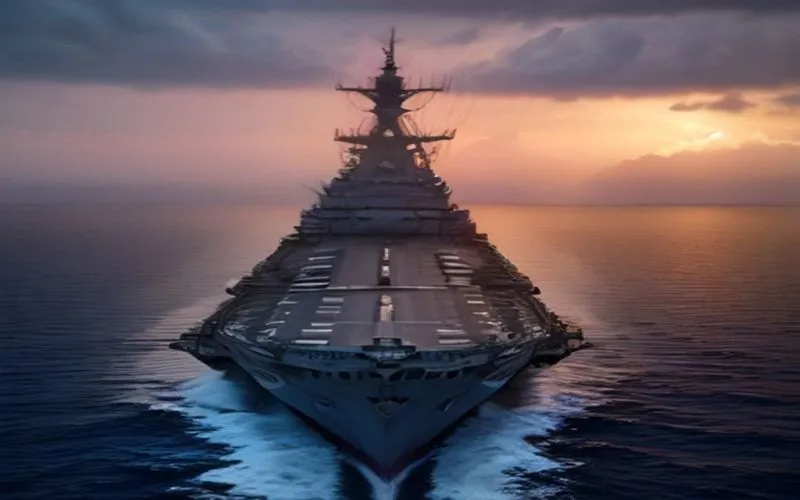
The U.S. Navy's force posture in the Middle East is undergoing a major shift as the USS Abraham Lincoln Carrier Strike Group (CSG) finally concludes its historic combat deployment. After spending more than 277 days at sea—marking one of the longest deployments in the modern era of American flattops—the Nimitz-class supercarrier is transiting back toward the U.S. Pacific Command area of responsibility. Operating as the tip of the spear during Operation Epic Fury, the Lincoln and its embarked Carrier Air Wing 9 launched over 10,000 sorties and dropped more than 1.5 million pounds of ordnance while enforcing critical maritime blockades in the northern Arabian Sea.
Relief and Rotations in the Arabian Sea
As the Lincoln departs the U.S. Central Command (CENTCOM) area of responsibility, the U.S. Navy is maintaining its vital dual-carrier presence in theater. The forward-deployed carrier USS George Washington has officially assumed watch in the Arabian Sea, joining the USS George H.W. Bush. The Washington, homeported in Yokosuka, Japan, transited through the Malacca Strait to take up station after completing a critical pierside Planned Incremental Availability. Just prior to entering the CENTCOM zone, the 34-year-old warship achieved a monumental aviation milestone by completing its 200,000th fixed-wing trap, underscoring the relentless operational tempo and readiness of naval aviation personnel.
Carrier Air Wing Compositions and Capabilities
Both deployed strike groups feature advanced fixed-wing and rotary assets tailored for high-intensity power projection and regional security. The USS George Washington hosts Carrier Air Wing 5, which notably includes a Navy-operated squadron of F-35C Lightning II Joint Strike Fighters (VFA-147 "Argonauts"), alongside three squadrons of F/A-18E/F Super Hornets, EA-18G Growlers for electronic warfare, E-2D Hawkeyes for airborne command and control, and specialized helicopter and logistics units. In comparison, the returning USS Lincoln also embarked an F-35C squadron, though operated by the U.S. Marine Corps, illustrating the integrated nature of modern carrier air operations.
Fleet-Wide Readiness and Maintenance Strain
The grueling deployment lengths experienced by ships like the Lincoln continue to highlight broader systemic strains across the U.S. Navy's carrier fleet. Upon its return to Naval Base San Diego, the Lincoln is scheduled to enter a complex Drydocking Planned Incremental Availability (DPIA), a maintenance cycle that could be extended due to the heavy wear and tear accumulated during months of uninterrupted combat operations. Concurrently, other assets across the continental United States—such as the USS Dwight D. Eisenhower and USS Carl Vinson—are actively working up off the coasts to maintain the necessary global rotation cycle and ensure persistent maritime dominance.
Bu haber, Ajans Savunma editoryal standartları çerçevesinde Yapay Zeka destekli algoritmalar tarafından orijinal kaynaktaki teknik verilere sadık kalınarak yeniden derlenmiştir. Orijinal Kaynak: The War Zone (Global)


Yorumlar (0)
Henüz yorum yapılmamış. İlk yorumu siz yapın!
Bir Yorum Bırakın