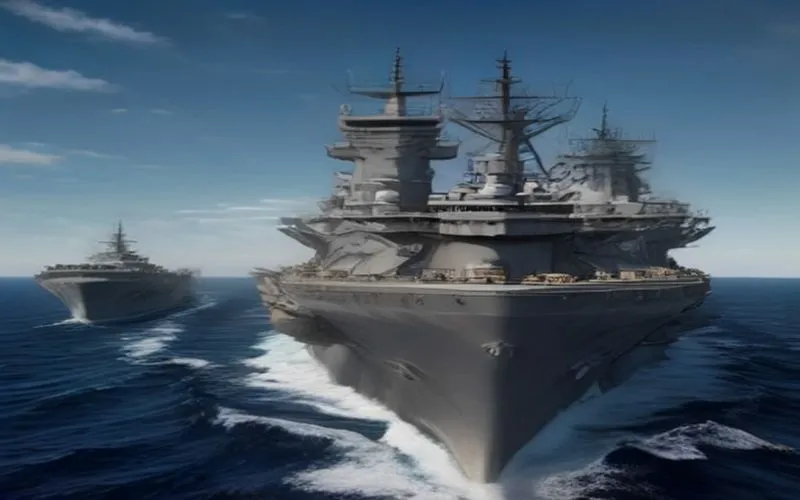
The U.S. Navy’s Ford class aircraft carriers have experienced significant attention recently, driven by potential major alterations to their core design elements. While possible sweeping modifications to catapults, weapons elevators, and island superstructures remain under evaluation for future vessels, concrete changes are already materializing. Most notably, designers have integrated a defensive capability found on all Cold War-era Nimitz class flattops: dedicated radar illuminators designed to guide surface-to-air missiles.
The Return of the Mk 95 Radar Illuminators
The incorporation of the Mk 95 radar illuminators on the future USS John F. Kennedy (CVN 79) became evident during recent imagery showing the vessel departing Newport News, Virginia, for acceptance sea trials. These illuminators are critical for guiding the RIM-162 Evolved Sea Sparrow Missiles (ESSMs). The necessity for this legacy feature is directly connected to the decision to phase out the complex and problematic Dual Band Radar (DBR) suite installed on the lead ship, the USS Gerald R. Ford.
Dating back to the 1970s, the Mk 95 system was originally engineered to support RIM-7 Sparrow variants utilizing semi-active radar homing. When a warship detects an incoming airborne threat, it cues the defensive missile, launches it, and uses illuminators like the Mk 95 to 'paint' the target with radar energy. The missile's seeker then passively homes in on the reflected energy throughout its terminal flight phase. Although newer Block 2 ESSMs feature active guidance and data links reducing the need for continuous illumination, older Block 1 variants still heavily rely on these systems.
Overcoming Dual Band Radar Complexities
The inclusion of the Mk 95 on the John F. Kennedy stems from the abandonment of the original DBR configuration intended for the Ford class. The DBR combined the AN/SPY-3 X-band AESA radar and the AN/SPY-4 S-band phased array to handle horizon search, fire control, and volume tracking simultaneously. However, integrating this multi-band software and hardware architecture proved exceptionally difficult and costly, driving massive budget overruns during the program's initial phases.
As a result, the Navy transitioned away from the DBR, opting instead for Raytheon’s AN/SPY-6(V)3 Enterprise Air Surveillance Radar (EASR) fixed-face arrays on CVN 79 and subsequent carriers. To make up for the tracking and illumination functions originally consolidated within the DBR, the new ships utilize the AN/SPQ-9B horizon search radar alongside the Mk 9 Tracker Illuminator System, housing the crucial Mk 95 units.
Broader Fleet Upgrades and Program Evolution
Beyond radar modifications, the Ford class continues to undergo continuous technological maturation. The John F. Kennedy is slated to feature advanced combat management systems and a Block II variant of the Navy’s Cooperative Engagement Capability (CEC) networked sensor architecture. Defensive armament suites are also adapting to incorporate a mix of Rolling Airframe Missile (RAM) Block 2 variants and both Block 1 and Block 2 ESSMs.
Despite persistent delays and cost overruns affecting the broader construction schedule—affecting subsequent hulls like the future USS Enterprise and USS Doris Miller—the Ford class design is actively evolving based on real-world operational lessons. As the U.S. Navy refines its surface combatant technologies, integrating reliable legacy subsystems alongside cutting-edge active arrays ensures robust defense against modern anti-ship cruise missiles and evolving aerial threats.
Bu haber, Ajans Savunma editoryal standartları çerçevesinde Yapay Zeka destekli algoritmalar tarafından orijinal kaynaktaki teknik verilere sadık kalınarak yeniden derlenmiştir. Orijinal Kaynak: The War Zone (Global)



Yorumlar (0)
Henüz yorum yapılmamış. İlk yorumu siz yapın!
Bir Yorum Bırakın