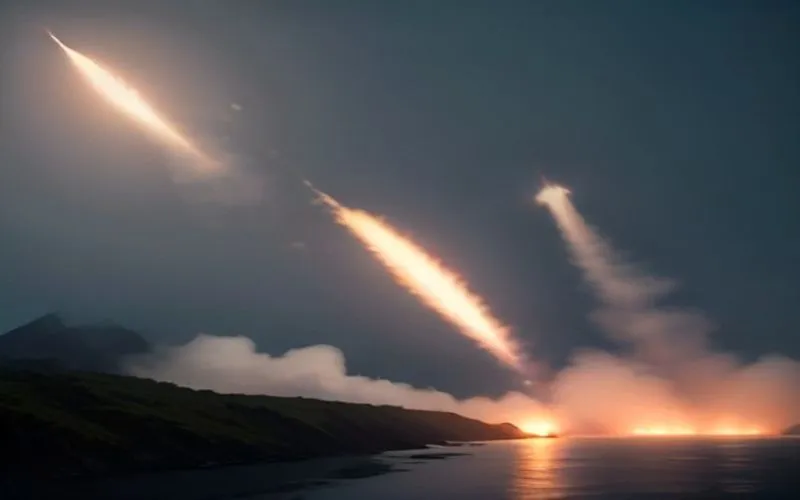
China has once again demonstrated its formidable space launch cadence and technical resilience by successfully executing back-to-back orbital missions over a single weekend. The operations involved the deployment of a new batch of Guowang megaconstellation satellites utilizing the Long March 12 launch vehicle, followed swiftly by the launch of a developmental Earth observation satellite for the United Arab Emirates aboard a Long March 2C rocket. These timely and successful missions provide a vital morale and operational boost to China's sprawling state-driven and commercial space sectors, coming on the heels of recent scrutiny over rocket anomalies.
Long March 12 Successfully Deploys Guowang Satellites
The Long March 12 lifted off from pad 2 at the Hainan commercial space launch center, carrying a fresh batch of operational satellites for the strategic Guowang low Earth orbit constellation. Developed by the China Academy of Space Technology (CAST), these spacecraft represent the 24th operational batch for the ambitious program, bringing the total number of deployed satellites closer to the ultimate goal of roughly 13,000 units. The mission showcased the rapid turnaround capabilities of the Hainan facility, which successfully accommodated the launch preparations with impressive speed.
Crucially, the successful flight of the Long March 12—which relies on the YF-100K engine family—provided immediate reassurance to aerospace engineers. The flawless launch occurred less than a week after the explosive failure of a Long March 7A rocket. By successfully reaching orbit, the Long March 12 mission strongly indicated that the root cause of the previous anomaly was not systemic to the foundational YF-100 engine architecture, thereby averting a potentially catastrophic and widespread grounding of China's primary launch vehicle fleets.
International Cooperation: UAE Earth Observation Satellite Launched
Demonstrating its growing footprint in the international commercial launch market, China followed the Guowang mission with a successful launch for the United Arab Emirates. A hypergolic Long March 2C rocket blasted off from the Taiyuan Satellite Launch Center, carrying the "Satellite for Earth Observation" (SEO) into orbit. Facilitated by the China Great Wall Industry Corporation (CGWIC), this mission underscores the deepening aerospace ties between Beijing and regional powers in the Middle East.
The SEO satellite is an advanced initiative spearheaded by the National Space Science and Technology Center (NSSTC) at UAE University, developed in close collaboration with the UAE Space Agency and Chinese institutional partners. Designed to enhance environmental monitoring, natural resource management, and strategic planning capabilities, the satellite builds upon previous cooperative milestones, such as the flight of the hyperspectral Satellite 813. This partnership highlights how space technology sharing is increasingly utilized as a diplomatic and strategic instrument.
Strategic Implications for China's 2026 Launch Manifest
These twin missions mark China's 58th and 59th orbital launch attempts of 2026, keeping the nation firmly on track to achieve its ambitious target of over 100 launches for the calendar year. The rapid execution underscores the maturity and redundancy built into China's military-civil fusion aerospace industrial base. Furthermore, the ability to rapidly diagnose or compartmentalize launch anomalies without halting the entire operational manifest highlights a high degree of programmatic resilience.
As commercial rocket developers like LandSpace and Galactic Energy prepare for upcoming orbital and recovery attempts with vehicles like the Zhuque-3 and Pallas-1, China's state-owned and commercial launch ecosystems continue to push the boundaries of cadence and reliability. The successful navigation of this recent technical hurdle ensures that Beijing's expansive military and civilian space ambitions, including the rapid deployment of national security and communication megaconstellations, will proceed largely unimpeded.
Bu haber, Ajans Savunma editoryal standartları çerçevesinde Yapay Zeka destekli algoritmalar tarafından orijinal kaynaktaki teknik verilere sadık kalınarak yeniden derlenmiştir. Orijinal Kaynak: SpaceNews



Comments (0)
No comments yet. Be the first to comment!
Leave a Comment