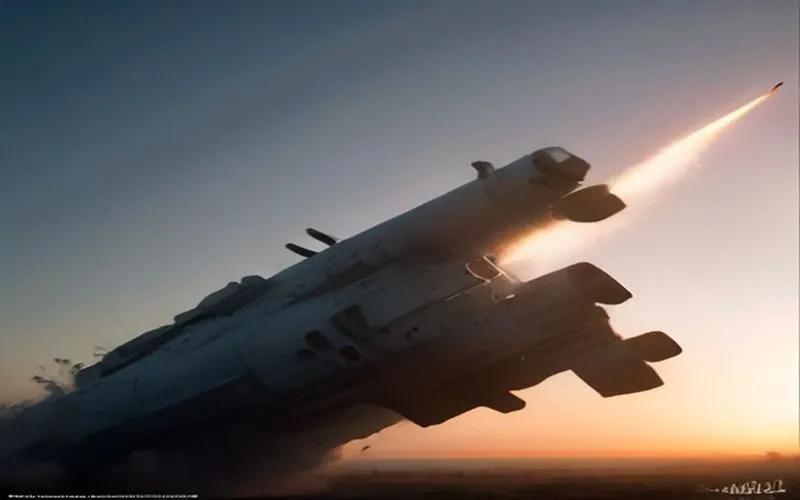
During two of the most intense recent major conflicts in the Middle East, the U.S. Army successfully neutralized more than 1,400 Iranian missiles and drones. This critical operational data was revealed by Lt. Gen. John Rafferty, commander of the U.S. Army Space and Missile Defense Command, Joint Functional Component Command for Integrated Missile Defense, and Joint Task Force-Gold. Speaking at the Space and Missile Defense Symposium (SMD) in Huntsville, Alabama, Rafferty provided unprecedented context regarding the massive volume of high-end interceptions performed by American air defense assets during these high-intensity engagements.
The Scale of the Air Defense Engagement
According to Lt. Gen. Rafferty, the 32nd Army Air and Missile Defense Command (AAMDC), headquartered at Fort Bliss, Texas, has been operating through what is officially categorized as the largest air and missile defense fight in U.S. military history over the past 14 months. During the 12-day war between Iran and Israel, the command successfully engaged 125 ballistic missiles. Furthermore, during Operation Epic Fury, over 1,200 complex ballistic, cruise missile, and unmanned aerial system (UAS) threats were neutralized.
The 32nd AAMDC relies on a multi-tiered defense architecture, heavily utilizing systems such as the Terminal High Altitude Area Defense (THAAD), the Patriot surface-to-air missile system, and advanced counter-UAS platforms. While these systems have demonstrated exceptional combat effectiveness, the sheer volume of incoming threats required an unprecedented expenditure of advanced interceptor munitions.
Operational Integration and Regional Architecture
The extensive air defense operations were not conducted in isolation. Earlier congressional testimony from U.S. Central Command (CENTCOM) chief Adm. Brad Cooper highlighted that Operation Epic Fury fully operationalized and validated a combined Middle East Air Defense (MEAD) network. For the first time in modern history, U.S. air defenders operated side-by-side with regional partner nations across integrated national architectures.
Data provided by CENTCOM noted that the broader coalition architecture intercepted over 6,000 one-way attack drones and more than 1,500 ballistic missiles targeted at U.S. forces, Israel, and regional Arab partners. While the U.S. Navy and Air Force also contributed heavily through ship-launched Standard Missiles (such as the SM-3 and SM-6) and tactical aircraft, the U.S. Army's specific figures account for a significant portion of the total neutralization metrics.
Magazine Depth Crisis and Future Defense Strategies
The staggering consumption rate of high-end interceptors has severely impacted U.S. military magazine depth. Assessments by the Center for Strategic and International Studies (CSIS) indicate that U.S. inventories of Patriot and THAAD interceptors have plummeted significantly since the commencement of these hostilities, leading to heavy reliance on backfilling supplies for partner nations and stressing the industrial base.
Addressing these critical supply chain challenges at the SMD symposium, Lt. Gen. Rafferty emphasized that relying solely on interceptor production is unsustainable. He advocated for a more holistic, comprehensive missile defeat strategy that integrates:
- Non-Kinetic Capabilities: Expanded deployment of electronic warfare and directed energy weapons.
- Advanced Command and Control: Cross-domain data strategies to accelerate target acquisition and decision-making cycles.
- Cost-Effective Mixes: Developing a wider, cheaper array of counter-measures to preserve expensive high-end missile stocks for pacing threats.
As the geopolitical landscape in the Middle East remains volatile, the heavy drain on U.S. air defense stockpiles continues to prompt critical evaluations regarding overall military readiness and the capacity to sustain concurrent high-intensity conflicts globally.
Bu haber, Ajans Savunma editoryal standartları çerçevesinde Yapay Zeka destekli algoritmalar tarafından orijinal kaynaktaki teknik verilere sadık kalınarak yeniden derlenmiştir. Orijinal Kaynak: The War Zone (Global)


Comments (0)
No comments yet. Be the first to comment!
Leave a Comment