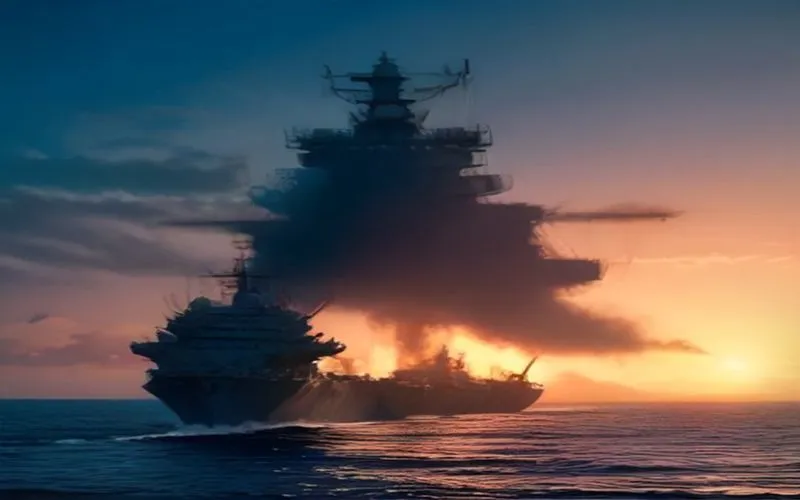
As global geopolitical tensions persist, the operational tempo of the United States Navy remains exceptionally high. The latest open-source intelligence and official reports outline the current deployment status of the U.S. Navy's nuclear-powered supercarriers and amphibious ready groups. The U.S. Navy aircraft carrier fleet continues to serve as the cornerstone of American power projection, managing simultaneous deterrence missions in the Middle East and the Indo-Pacific theater.
Middle East Operations and the Arabian Sea Blockade
In the U.S. Central Command (CENTCOM) area of responsibility, dual-carrier operations are currently in full effect. The Nimitz-class supercarriers USS Abraham Lincoln and USS George H.W. Bush are operating in the northern Arabian Sea. These warships, alongside over 20 other Navy surface combatants, are actively enforcing a blockade of Iranian ports and coastal cities.
According to CENTCOM data, operations have involved redirecting dozens of commercial vessels and boarding select ships to ensure compliance. The USS Abraham Lincoln is notably approaching its ninth month on deployment, highlighting the extended timelines increasingly demanded of surface combatants and their embarked air wings. While family members have raised concerns regarding prolonged deployment conditions aboard the flattop, U.S. 5th Fleet leadership has reaffirmed that the ship remains fully capable of executing all assigned missions.
Indo-Pacific Presence and South China Sea Patrols
Shifting focus to the Western Pacific, the USS George Washington is actively conducting operations in the South China Sea. Following a recent port call in Vietnam, open-source flight tracking placed the four-ship strike group west of the Philippines near Luzon. The carrier is escorted by the guided-missile cruiser USS Robert Smalls and guided-missile destroyers USS Shoup and USS Benfold.
- Carrier Air Wing 5 assets, including CMV-22B Ospreys, have been tracked executing logistical runs to regional facilities like Clark Air Base.
- The strike group provides a visible deterrent and rapid-response capability amid ongoing territorial disputes and strategic competition in the region.
- Escort vessels provide integrated air defense and anti-submarine warfare protection essential for high-value unit survivability.
Meanwhile, the USS Theodore Roosevelt recently returned to San Diego following its participation in the massive Rim of the Pacific (RIMPAC) 2026 exercise. The carrier recently embarked families for a traditional tiger cruise, but its future deployment destination—whether returning to the Middle East to maintain dual-carrier coverage or pivoting back to the Western Pacific—depends heavily on ongoing diplomatic developments.
The 'Gator Navy' and Amphibious Readiness Strains
Beyond the nuclear-powered carriers, the U.S. Marine Corps and Navy's amphibious fleet—often referred to as the 'Gator Navy'—faces persistent high demand coupled with inventory constraints. General Eric Smith, Commandant of the U.S. Marine Corps, has repeatedly emphasized that combatant commanders request significantly more Amphibious Ready Groups and Marine Expeditionary Units (ARG-MEUs) than are currently available.
To mitigate these shortfalls, the Navy has begun experimenting with alternative force structures, such as deploying a Littoral Combat Force centered around a single amphibious transport dock ship supported by distributed nodes. Other units, like the USS Makin Island and USS Essex, are progressing through their respective work-up cycles following major exercises.
Overall, the global disposition of the U.S. fleet underscores the immense logistical and operational strain required to maintain continuous maritime dominance across multiple theaters simultaneously.
Bu haber, Ajans Savunma editoryal standartları çerçevesinde Yapay Zeka destekli algoritmalar tarafından orijinal kaynaktaki teknik verilere sadık kalınarak yeniden derlenmiştir. Orijinal Kaynak: The War Zone (Global)

Yorumlar (0)
Henüz yorum yapılmamış. İlk yorumu siz yapın!
Bir Yorum Bırakın