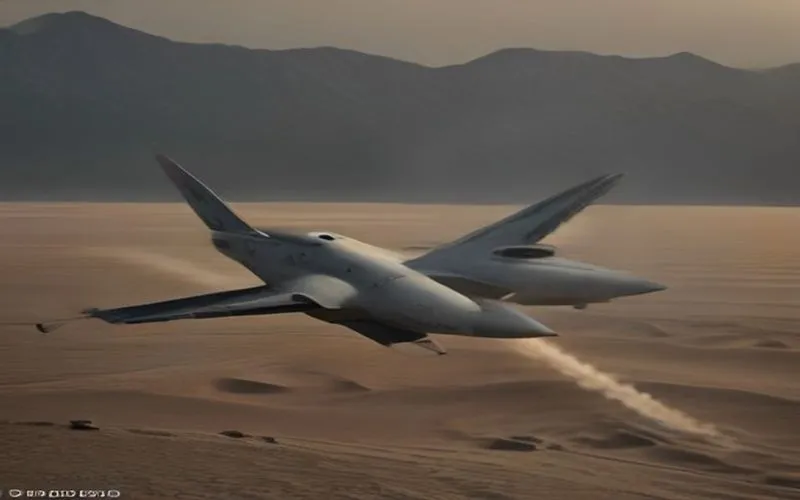
The U.S. Air Force is actively seeking innovative solutions to modernize its training infrastructure through the acquisition of advanced target drones capable of mimicking a wide spectrum of modern airborne threats. According to a recently published Request for Information (RFI), the military branch aims to procure a diverse family of unmanned platforms that can accurately represent everything from inexpensive hobby drones to highly advanced adversary stealth fighters, heavy bombers, and large-scale surveillance aircraft. By leveraging commercial, dual-use, and non-developmental technologies, the Pentagon hopes to secure scalable and cost-effective systems that can be treated as expendable during rigorous live-fire and tactical exercises.
Simulating Fifth-Generation Fighters and Advanced Maneuvers
To adequately prepare pilots for modern air combat, the envisioned target drones must push technological boundaries in performance and signature management. The RFI specifies that platforms designed to replicate fighter aircraft must feature supersonic capabilities exceeding Mach 1.6 at an altitude of 40,000 feet. Furthermore, these systems require high-agility and high-G combat maneuverability, precise low-observable Radar Cross-section (RCS) profiles, multi-spectral infrared signatures, active radio frequency emissions, and integrated electronic attack capabilities. Replicating the elusive nature of fifth-generation stealth jets ensures that missile seekers and radar operators can test their systems against realistic, high-threat scenarios.
Replicating Large-Scale Aircraft and Strategic Bombers
Beyond high-performance fighter analogs, the Air Force also requires target drones tailored to simulate larger military assets. For C-130-sized multi-engine aircraft, the priority shifts toward matching physical scale, slow subsonic flight envelopes, and propeller or turbofan propulsion characteristics. These platforms will help verify missile seeker guidance and warhead lethality against bulky airframes. For strategic bombers and airborne early warning and control (AWACS) planes, the focus centers on replicating massive physical dimensions and heavy-aircraft radar signatures to test long-range interception capabilities.
Addressing Gaps in Legacy Training Infrastructure
Historically, military forces have relied on converted retired aircraft, such as the QF-16, or specialized subscale subsonic targets like the BQM-167A to test weapon systems. However, while retired airframes provide a useful baseline for fourth-generation threats, they fall short when trying to economically or accurately portray modern stealth fighters, massive bombers, or diverse unmanned aerial vehicle (UAV) groupings ranging from small Group 1 swarms to high-altitude Group 5 platforms. By turning to private industry for commercial and dual-use innovations, the U.S. military intends to bridge these capability gaps and ensure warfighters remain prepared for multi-domain conflict environments.
Bu haber, Ajans Savunma editoryal standartları çerçevesinde Yapay Zeka destekli algoritmalar tarafından orijinal kaynaktaki teknik verilere sadık kalınarak yeniden derlenmiştir. Orijinal Kaynak: Defense News (Global)


Yorumlar (0)
Henüz yorum yapılmamış. İlk yorumu siz yapın!
Bir Yorum Bırakın