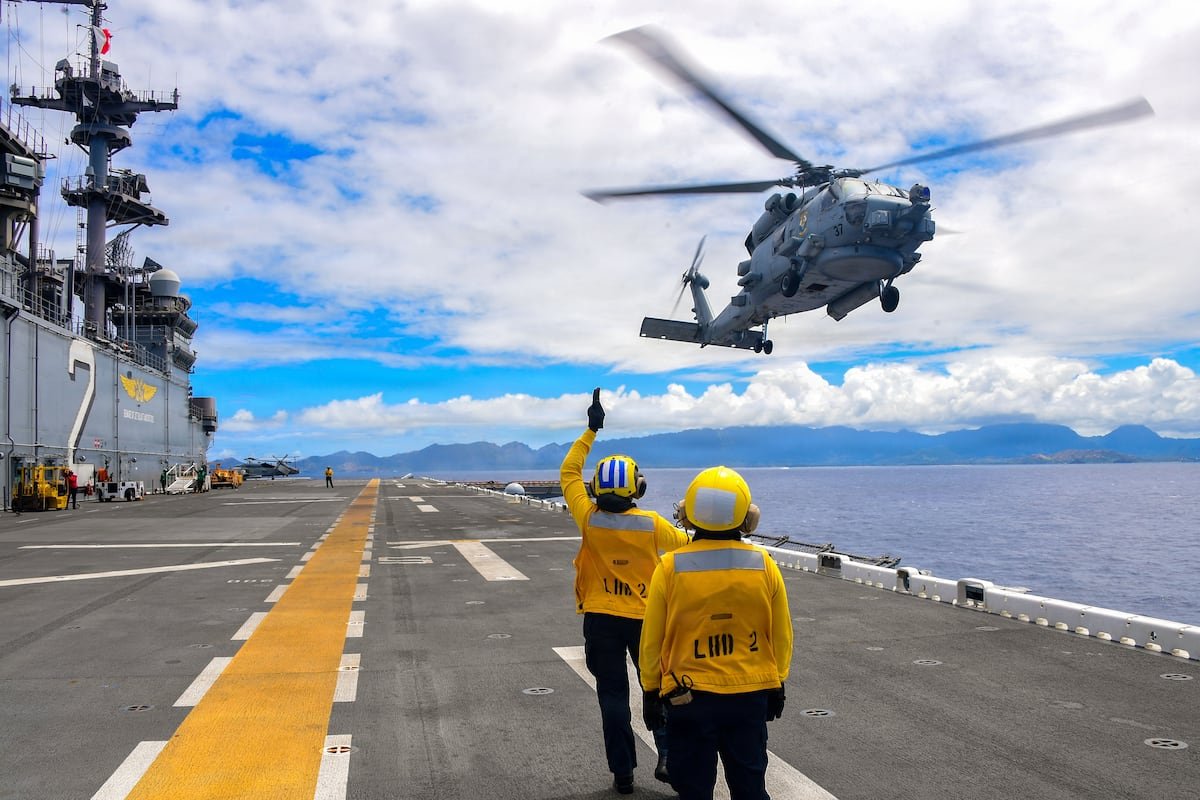
The U.S. Navy tested artificial intelligence-powered sonar to target submarines during the multinational Rim of the Pacific exercise in July.
SensorMAX, developed by Lockheed Martin, uses AI and machine learning to analyze acoustic sensor data, update the sensor model — and then immediately transmit the updates over the air to anti-submarine warfare, or ASW, platforms.
During RIMPAC maneuvers near Hawaii, Navy MH-60R helicopters dropped sonobuoys, which fed data to SensorMAX. It in turn assisted the crews with target identification.
“Ground operators retrained SensorMAX’s models on new sounds in minutes, then transmitted AI-enhanced undersea intelligence OTA [over the air] using an encrypted data link directly back to the helicopter and the fleet,” according to a Lockheed Martin news release.
Lockheed described the system as the “Navy’s AI portable sonar expert.”
“Taking in subsurface acoustic data from a network of sensors, SensorMAX provides a continuous data stream to the aircrew and sends information to the ground station,” the company continued. “When a new target is identified, system operators label the identified noise signature, retrain the model on the new data and push a small update packet back to the aircrew.”
Lockheed Martin’s SuperMAX demonstrated during Pacific Rim 2026. (Lockheed Martin).The system allows aircrews to manage up to eight simultaneous sonobuoy surveillance feeds, “doubling the capacity of legacy capabilities,” Lockheed said.
The company estimated that each retraining cycle for the model takes under five minutes.
SensorMAX integrates data from a variety of sensors, which makes it useful for air and ground operations as well as naval, according to Lockheed Martin.
“Lockheed Martin’s collaboration with FUSE Inc. enables secure, resilient software delivery to deployed aircraft, allowing SensorMAX’s trained AI models and mission software to be updated rapidly without interrupting operations,” the company said.
“By demonstrating platform-agnostic AI intelligence and classification, the future fleet can leverage any acoustic sensor to expand the protective ring around high-value assets and accelerating the ASW kill chain,” Lockheed Martin continued.
China is also integrating AI into ASW. Chinese media claimed last year that researchers had developed AI which evaluates data from multiple sources, including sonobuoys as well as data on water temperature and salinity.
About Michael PeckMichael Peck is a correspondent for Defense News and a columnist for the Center for European Policy Analysis. He holds an M.A. in political science from Rutgers University. Find him at theuncommondefense.com. His email is mikedefense1@gmail.com.
Share:More In MilTechTrust between operators, CCAs starts with simulations: Former Air Force secretarySimulations and exercises will be key to boosting trust between operators and CCAs, according to former U.S. Air Force secretary Frank Kendall.Celebrating 40 years of Defense NewsSince 1986, Defense News has been the authoritative voice for the world's defense decision-makers.Guardsman learns to fly autonomous Black Hawk in less than an hourIn a training first, an Army National Guardsman used a tablet to control Sikorsky's optionally piloted Black Hawk and plan its task during an exercise.Recap: Highlights from the US Army’s 2025 conference in WashingtonThe Army continues to transform, with efforts focused on next-gen weaponry, long-range artillery, unmanned systems and much more.Pentagon stages first ‘Top Drone’ school for operators to hone skillsIndustry and military drone operators flew tethered and untethered first-person drones through a course designed to test endurance and maneuverability.

Yorumlar (0)
Henüz yorum yapılmamış. İlk yorumu siz yapın!
Bir Yorum Bırakın