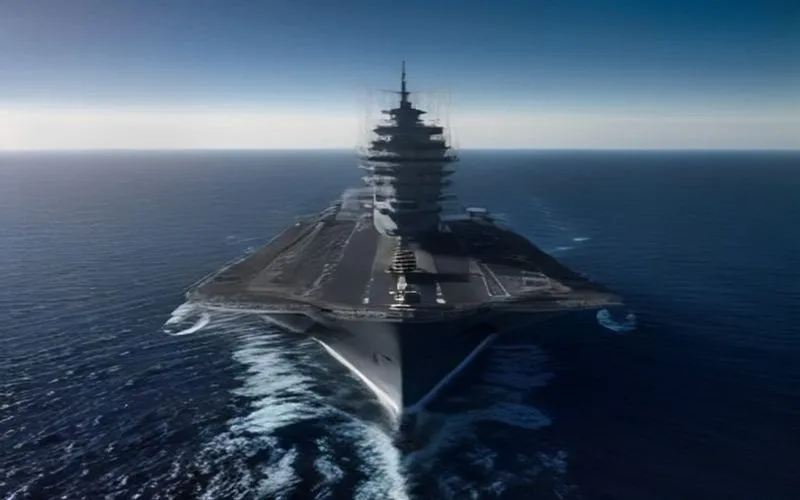
The U.S. Navy is reportedly evaluating a major change to the Ford-class aircraft carrier design that would move the island superstructure further forward on the flight deck. Political pressure is said to be driving the service to reposition the island on aesthetic grounds, aiming to make modern nuclear-powered supercarriers look more like World War II-era warships. While similar proposals have targeted systems like the Electromagnetic Aircraft Launch System (EMALS) and Advanced Weapons Elevators (AWE), shifting the island itself represents an exceptionally complex and costly engineering hurdle.
Operational Benefits of the Ford-Class Island Layout
For the U.S. Navy, the placement of the island on the Gerald R. Ford-class was not an arbitrary or purely aesthetic decision. Between 1996 and 2000, naval planners examined roughly 75 different conceptual configurations, exploring various hullforms and flight deck layouts with islands placed at numerous points. Ultimately, the service settled on a design where the island is positioned 140 feet further aft compared to the preceding Nimitz class.
This distinct placement optimizes the total open deck space, creating roughly five acres of usable flight deck area. According to former and current carrier commanders, the configuration provides crucial operational benefits:
- Enhanced flexibility for cyclic flight operations, allowing rapid aircraft recovery and relaunch.
- Improved traffic flow that minimizes the need for breaks in flight deck operations during troubleshooting.
- Enhanced safety margins for incoming aircraft by reducing stern-generated turbulence.
- Better integration with advanced weapon elevators and rapid refueling stations.
Engineering Challenges and Financial Costs of Relocating the Superstructure
Moving the island superstructure at this advanced stage of the program would involve far more than simply shifting a physical structure. The island is deeply integrated into the ship’s architecture, housing vital command spaces, radar arrays, and communication systems. Relocating it would directly impact seakeeping, structural stability, and weight distribution across the entire hull.
Previous naval studies conducted during earlier administrative reviews indicated that redesigning the carrier to shift the island would cost billions of dollars and introduce multi-year delays. Given that the U.S. shipbuilding industrial base is already heavily strained—with Newport News Shipbuilding managing intense demands for nuclear submarines and surface combatants—further delays could severely exacerbate existing fleet readiness crises.
Geopolitical Implications and Fleet Readiness Pressures
The timing of these proposed modifications coincides with unprecedented operational demands on the U.S. Navy's carrier strike groups. Aging Nimitz-class carriers are experiencing prolonged deployments, high operational tempos, and growing crew fatigue amidst persistent global tensions, particularly in the Middle East. Any disruption or delay in delivering upcoming Ford-class hulls—such as the future USS John F. Kennedy, USS Enterprise, and USS Doris Miller—risks worsening a looming capability gap.
While international competitors like France and China are also exploring aft-positioned island designs for their next-generation carriers, recognizing the aerodynamic and deck-management advantages, the future of the U.S. program remains subject to ongoing political and congressional debates. Whether these design discussions will materialize into actual engineering changes or remain cautionary studies depends heavily on balancing naval tradition with urgent operational realities.
Bu haber, Ajans Savunma editoryal standartları çerçevesinde Yapay Zeka destekli algoritmalar tarafından orijinal kaynaktaki teknik verilere sadık kalınarak yeniden derlenmiştir. Orijinal Kaynak: The War Zone (Global)


Comments (0)
No comments yet. Be the first to comment!
Leave a Comment